
Derivation of the centripetal acceleration
The derivation of centripetal acceleration presented in the video follows a different approach from the one outlined below.
To derive the centripetal acceleration of an object in uniform circular motion, consider an object moving on a circle of radius $r$. Let $v$ be the speed of the object, which is constant.
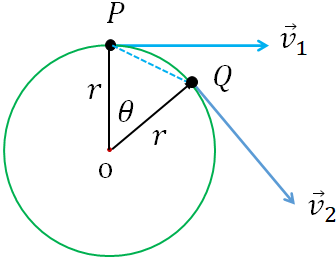
Now take two points on the circle, P and Q, separated by an angle $\theta$, as shown in the figure above. Let $\Delta t$ be the time the object takes to move from P to Q. At every moment, the velocity of the object is tangent to the circle, so the velocity vectors at P and Q point as shown. Let $\vec v_1$ be the velocity at P and $\vec v_2$ be the velocity at Q.
Next, move the vector $\vec v_2$ so that its tail meets the tail of $\vec v_1$. From the geometry of the first figure, the angle between the two vectors is $\theta$. Now draw a vector (the red arrow) from the tip of $\vec v_1$ to the tip of $\vec v_2$.
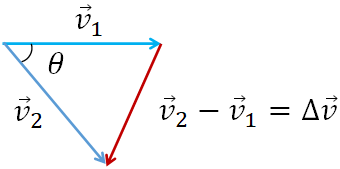
By the tip-to-tail method, the red arrow represents the vector $\vec v_2-\vec v_1$, which is the change in velocity $\Delta \vec v$.
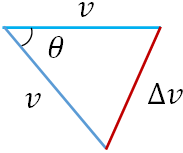
Since the speed is constant, $|\vec v_1|=v$ and $|\vec v_2|=v$. So, considering only the magnitudes of the vectors, we obtain the following triangle:
From the first figure, we have another triangle:
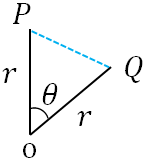
These two triangles are similar, so the ratios of their corresponding sides are equal. Therefore, we can write
$\dfrac{\Delta v}{PQ}=\dfrac{v}{r}$
Solving for $\Delta v$,
$\Delta v=\dfrac{v\,PQ}{r}$
Dividing by $\Delta t$, we get
$\dfrac{\Delta v}{\Delta t}=\dfrac{v}{r}\dfrac{PQ}{\Delta t}$
The left-hand side is the average acceleration, $\bar a$, and PQ is the distance the object travels in the time $\Delta t$. So $\dfrac{PQ}{\Delta t}$ is the average speed, $\bar v$, of the object. Substituting these, we get
$\bar a =\dfrac{v}{r}\,\bar v$
This is the average acceleration of the object over the time interval $\Delta t$. What we really want, however, is the instantaneous acceleration. To find it, we let the time interval become very small, because as $\Delta t$ shrinks, the average values approach the instantaneous values.
That is, as $\Delta t \rightarrow\:0$, $\bar a =a$ and $\bar v =v$, and we get
$a=\dfrac{v}{r}\,v$
$=\dfrac{v^2}{r}$
This is the centripetal acceleration.