
Practice questions
page1 page2 page3 page4 page5 page6 page7 page8Logarithmic and Exponential Functions
34. Solve the following equations.
(a) $16^{2x+1}=64^{x+3}$
(b) $\log_4(2x+4)=3$
(c) $2^{x+3}=5^x$
(d) $\log_2(x)+\log_2(x-7)=3$
Solution:
(a).
First, rewrite the equation so that both sides have the same base:
$(4^2)^{2x+1}=(4^3)^{x+3}$
$(4)^{2(2x+1)}=(4)^{3(x+3)}$
Now the bases are the same, so the exponents must be equal:
$2(2x+1)=3(x+3)$
Now, solve for $x$:
$4x+2=3x+9$
Solving for $x$:
$x=7$
(b).
Write the logarithmic equation in exponential form:
$4^3=2x+4$
$64=2x+4$
Solving for $x$:
$x=30$
(c).
You cannot write this equation with the same base on both sides, so take the log of both sides:
$\log(2^{x+3})=\log(5^x)$
$(x+3)\log(2)=x\log(5)$
$x\log(2)+3\log(2)=x\log(5)$
Bring the $x$ terms together:
$x\log(2)-x\log(5)=-3\log(2)$
Factor out the $x$:
$x(\log(2)-\log(5))=-3\log(2)$
Divide by $(\log(2)-\log(5))$ to get $x$:
$x=\dfrac{-3\log(2)}{\log(2)-\log(5)}$
Using a calculator:
$x=2.269$
(d).
First combine the two logarithms on the left:
$\log_2(x(x-7))=3$
Now, write in exponential form:
$2^3=x(x-7)$
$8=x^2-7x$
This is a quadratic equation, write in standard form to solve:
$0=x^2-7x-8$
i.e., $x^2-7x-8=0$
Factoring:
$(x-8)(x+1)=0$
Applying zero-product rule:
$x-8=0$ or $x+1=0$
$x=8$ or $x=-1$
$x=-1$ gives a negative number inside the logarithm, so it cannot be a solution.
So, the solution is
$x=8$
35. Rewrite the following expression as a single logarithm.
(e) $3\log_p(x)+\dfrac{1}{2}\log_p(y)-\dfrac{3}{2}\log_p(z)$
Solution:
Write the coefficients of the logarithms as exponents using the formula $\log_a{x^p}=p\log_a x$:
$=\log_p(x^3)+\log_p(y^{1/2})-\log_p(z^{3/2})$
Combine them:
$=\log_p\left(\dfrac{x^3y^{1/2}}{z^{3/2}}\right)$
You can also write this as
$=\log_p\left(\dfrac{x^3\sqrt{y}}{\sqrt{z^3}}\right)$
36. Use the change-of-base formula to estimate the following logarithms to four decimal places.
(a) $\log_\pi(e)$
(b) $3\log_6 2.75$
Solution:
(a).
Use the change-of-base formula. Change the base to $e$, since there is an $e$ in the logarithm. (You can also change the base to $10$.)
$\log_\pi(e)=\dfrac{\ln(e)}{\ln (\pi)}$
Since $\ln (e)=1$:
$=\dfrac{1}{\ln (\pi)}$
$=\dfrac{1}{1.14473}$
$=0.8736$, after rounding to four decimal places.
(b).
Use the change-of-base formula:
$3\log_6 2.75= 3\cdot \dfrac{\log(2.75)}{\log(6)}$
Using a calculator:
$= 3\cdot \dfrac{0.4393327}{0.778151}$
$= 3\cdot 0.564585$
$= 1.6938$
37. Graph.
(a) $y=\left(\dfrac{2}{3}\right )^x$
(b) $y=\log_2 x$
Solution:
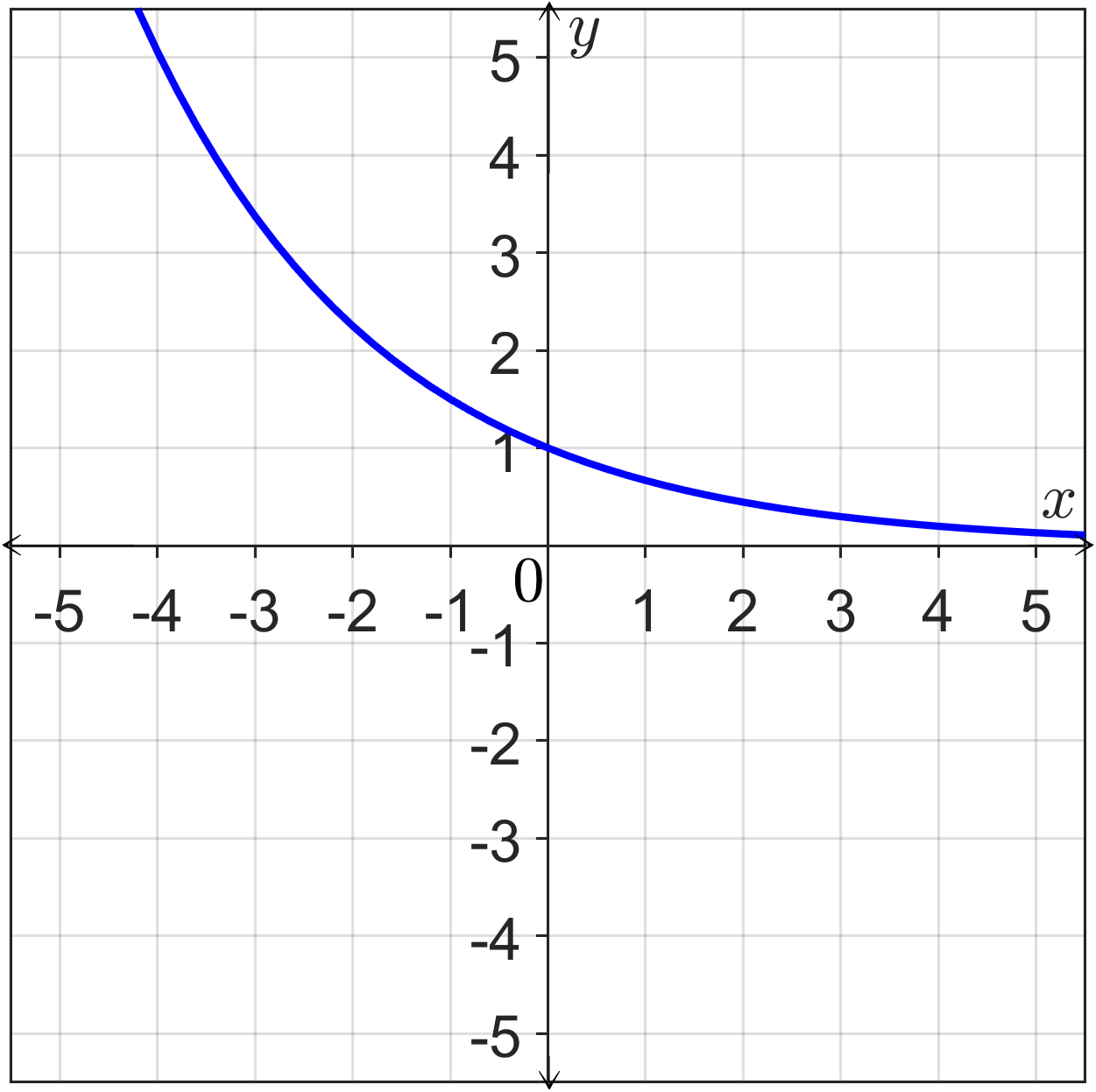
(a):
Graph of $y=\left(\dfrac{2}{3}\right )^x$:
| $x$ | $y$ | $(x, y)$ |
|---|---|---|
| $-2$ | ||
| $-1$ | ||
| $0$ | ||
| $1$ | ||
| $2$ |
(b).
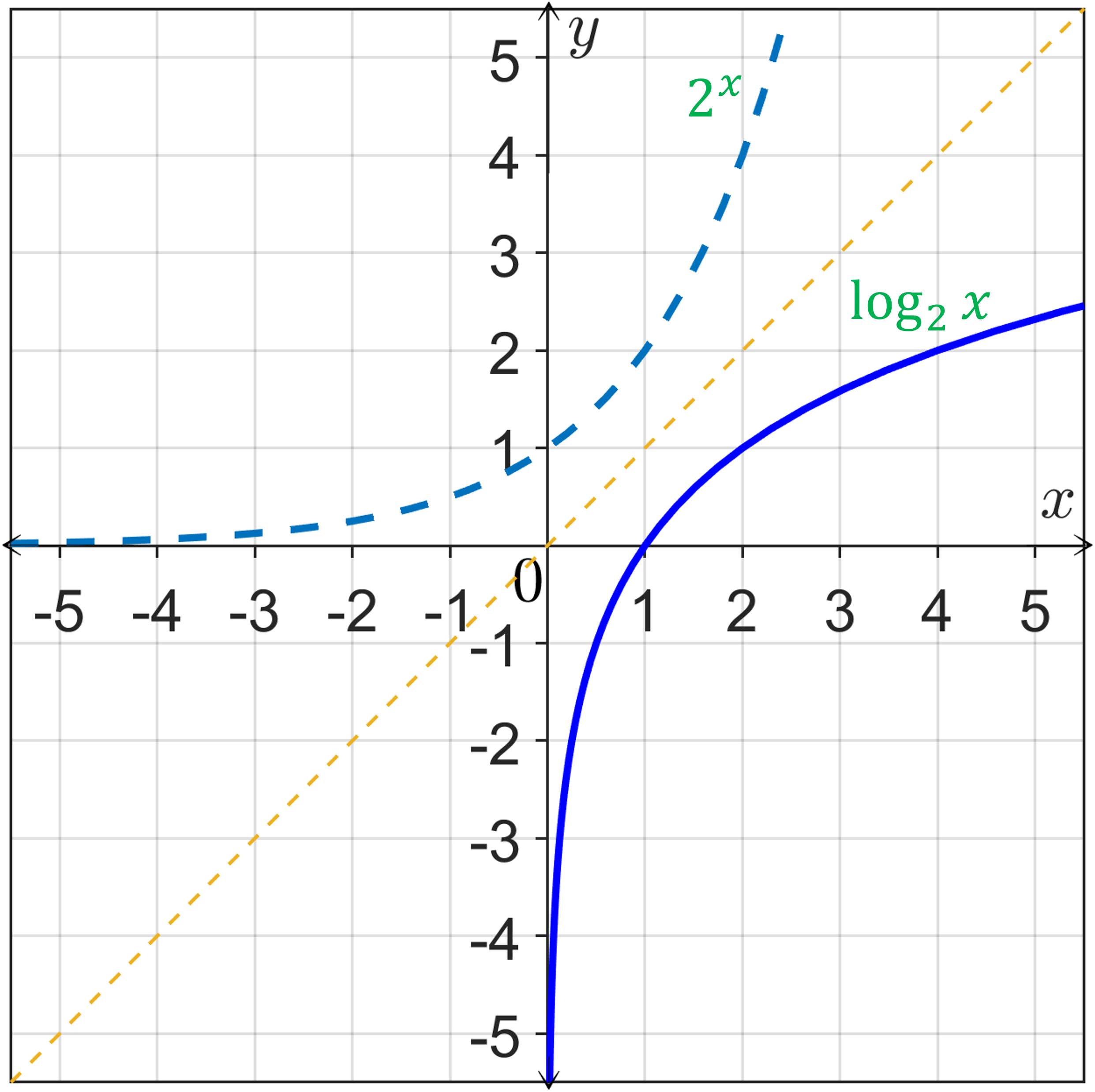
The logarithmic function is the inverse of the exponential function.
So, to draw the graph of $y=\log_2{x}$, draw the graph of $y=2^x$. Then draw the line $y=x$ as a mirror; the logarithmic graph is the mirror image of the exponential graph.
38. Solve the following problems using the interest formulas.
(a) What will be the amount $A$ in an account with an initial principal of \$4000 if interest is compounded continuously at a rate of 3.5% for 6 years? Also, how long does it take for the account to double?
(b) A college loan of \$29,000 is made at 3% interest compounded annually. After t years, the amount due, A, is given by the function $A(t)=29,000(1.03)^t$. If no payments are made, how long will it take for the amount due to reach \$35,000?
Solution:
(a)
For the interest compounded continuously, you should use the following formula:
$A=P e^{rt}$
$t$ is the number of years, $A$ is the amount after $t$ years, $P$ is the principal (the initial deposit, or the loan if money is borrowed), and $r$ is the interest rate.
You are given:
$P=4000\:\$$; $r=3.5\%=3.5/100=0.035$; and $t=6$ years. You need to find the amount $A$ after $6$ years. Substituting $P$, $r$, and $t$ into the equation:
$A=4000 e^{0.035\cdot 6}$
$ =4000 e^{0.21}$
$ =4000 \cdot 1.2337$
$ =4934.71 \:\$$
This is one of the answers.
Next, find how long it takes to double the amount. That is, find the time $t$ for the amount to double.
The amount is doubled, so $A=2P$. Substituting this $A$ and $r$ into the formula:
$2P=Pe^{0.035t}$
Divide out $P$ and solve for $t$:
$2=e^{0.035t}$
To solve, take $\ln$ on both sides:
$\ln (2)= \ln(e^{0.035t})$
$\ln (2)= 0.035t\,\ln(e)$
Putting $\ln(e)=1$:
$\ln (2)= 0.035t$
Divide by $0.035$ to get $t$:
$t=\ln(2)/0.035=19.8$ years
(b).
The equation for the amount after $t$ years is given
$A(t)=29,000(1.03)^t$.
The initial deposit amount and the interest rate are already included in the equation, so we don't need to worry about those numbers.
You need to find the time $t$ for the amount to reach \$35,000.
Substitute $A=35000$ and solve for $t$:
$35000=29000(1.03)^t$
Divide both sides by $29000$ to isolate the exponent:
$1.2069=1.03^t$
This is an exponential equation. To solve for $t$, take the log of both sides:
$\log(1.2069)=\log(1.03^t)$
$\log(1.2069)=t\,\log(1.03)$
Divide both sides by $\log(1.03)$ to get $t$:
$\dfrac{\log(1.2069)}{\log(1.03)}=t$
Using a calculator:
$t=6.36$
This is the answer. So, after $6.36$ years, the loan amount will reach \$35,000.