
Linear inequalities in one variable
Introduction
An inequality is a sentence that contains <, ≤, > or ≥.
Examples:
$x\lt 5$
$2x-3\le 4$
$7y-1\gt 4(3y-1)$
$-9y+1\ge 2-4y$
The above inequalities have only one variable $x$ or $y$, so they are inequalities in one variable.
Like an equation, an inequality has a solution.
For the inequality $x\lt 2$, the solution is all real numbers less than $2$.
You can graph the solution on a number line, or write it in interval notation or set-builder notation.
Graph of $x\lt 2$:
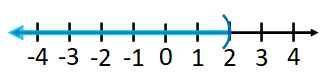
Instead of a parenthesis, you can also use an open circle, as shown below.
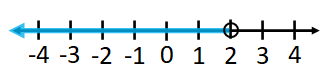
In the interval notation, $x\lt 2$ is $(-\infty, 2)$.
In the set-builder notation, $x\lt 2$ is $\{x|x\lt 2\}$.
Graph of $x\le 2$:
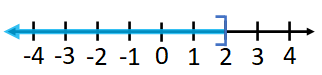
Note that there is now a bracket instead of a parenthesis, because the inequality includes an equal sign.
Instead of the bracket, you can also use a filled circle, as in the figure below.
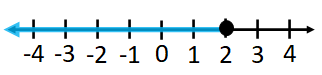
For $x\le 2$, the interval notation is $(-\infty, 2]$.
And the set-builder notation is $\{x|x\le 2\}$.
Graph of $x\gt 2$,
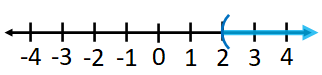
For $x\gt 2$, the interval notation is $(2, \infty)$.
And the set-builder notation is $\{x|x\gt 2\}$.
Graph of $x\ge 2$,
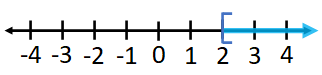
For $x\ge 2$, the interval notation is $[2, \infty)$.
And the set-builder notation is $\{x|x\ge 2\}$.
Note that if there is an equal sign with the inequality, then use the bracket (or a filled circle); if no equal sign, then use the parenthesis (or an open circle). For infinity ($\infty$ or $-\infty$), always use parenthesis.
Sections in this chapter
Solving linear inequality
The addition, subtraction, multiplication, and division properties of inequality, with worked examples.
Compound inequalities
Inequalities joined by ‘and’ or ‘or’: union and intersection of sets, and solving compound inequalities.