
Practice questions
page1 page2 page3 page4 page5 page6 page7 page85. Quadratic equations
24. Solve the following equations.
(a) $(t+5)^2=48$
(b) $y^2-14y+49=0$
Solution:
(a).
Use the square root property to solve:
$t+5=\sqrt{48}$ or $t+5=-\sqrt{48}$
Solving for $t$:
$t=-5+\sqrt{48}$ or $t=-5-\sqrt{48}$
Factoring the square root: $\sqrt{48}=\sqrt{16\cdot 3}=4\sqrt{3}$
$t=-5+4\sqrt{3}$ or $t=-5-4\sqrt{3}$
25. Find the value of $c$ such that $9x^2-30x + c = 0$ has exactly one solution.
Solution:
It is given that the quadratic equation has only one solution. So, the discriminant should be zero:
$b^2-4ac=0$
From the given equation, we have $a=9$ and $b=-30$, and we need to find $c$. Substitute the values of $a$ and $b$, and solve for $c$:
$(-30)^2-4\cdot 9c=0$
$900-36c=0$
Solving for $c$:
$c=25$
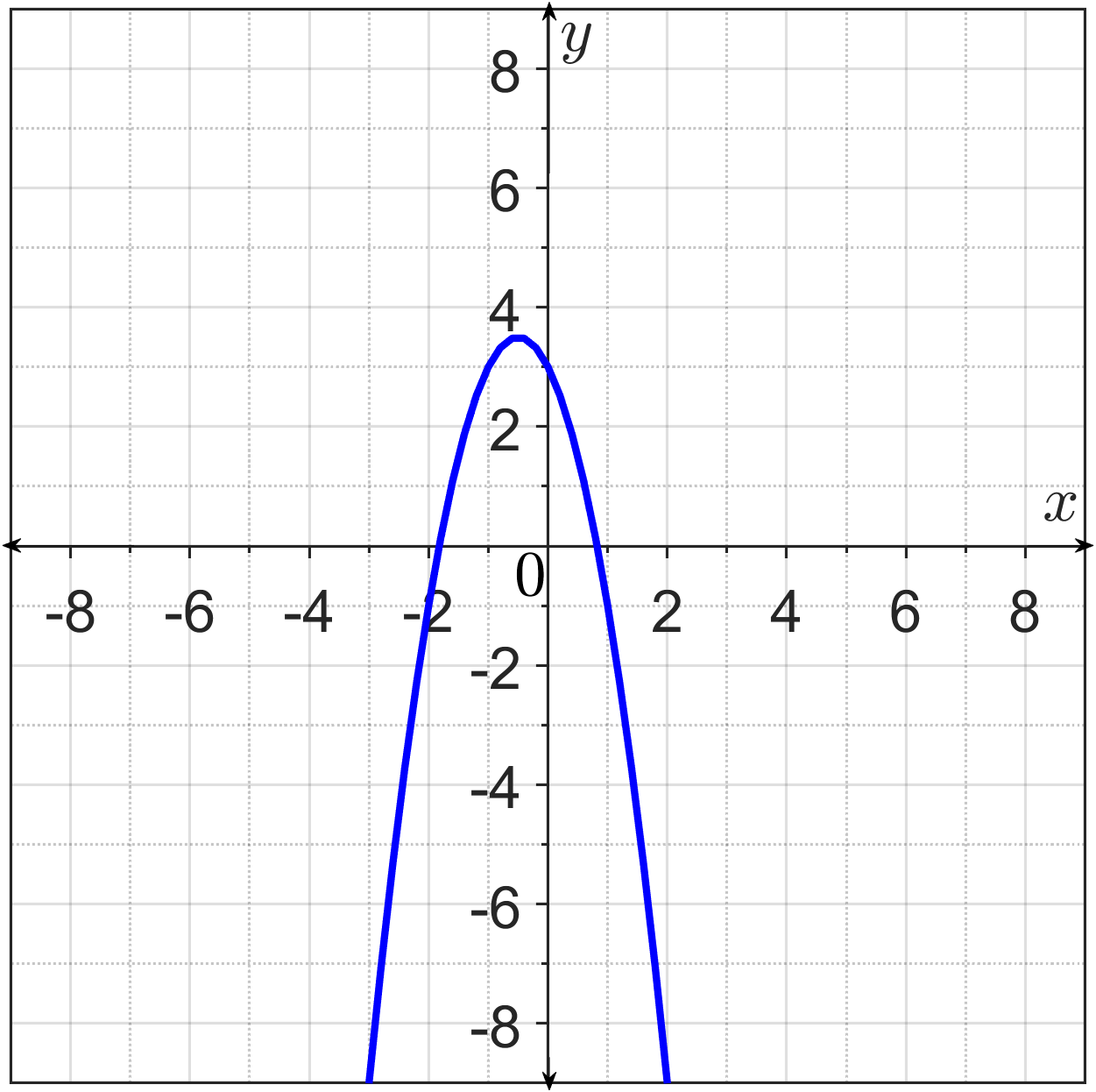
26. For the quadratic function $f(x)=-2x^2-2x+3$, find the following:
(a) The vertex
(b) The line of symmetry
(c) The maximum or minimum value
(d) The $x$-intercept
(e) The $y$-intercept
(f) The graph of the function.
Solution:
The quadratic function is
$f(x)=-2x^2-2x+3$
Here, $a=-2$; $b=-2$ and $c=3$
(a).
The vertex is $(h, k)$
We need to find $h$ and $k$:
$h=-\dfrac{b}{2a}=-\dfrac{(-2)}{2(-2)}$
$=-\dfrac{1}{2}$
To find the $k$, substitute $x=-\dfrac{1}{2}$ in the function:
$k=f(-1/2)=-2(-1/2)^2-2\cdot (-1/2)+3$
$=-2\cdot 1/4+1+3$
$=-1/2+4$
$=\dfrac{-1+4\cdot 2}{2}$
$=\dfrac{7}{2}$
So, the vertex is $\left(-\dfrac{1}{2}, \dfrac{7}{2}\right)$
(b).
The equation of the line of symmetry is
$x=h$
Substituting the value of $h$:
$x=-\dfrac{1}{2}$
(c)
$a$ is negative, so the function has a maximum value.
The maximum value of the function is $k$.
Thus the maximum value of the function $=\dfrac{7}{2}$
(d).
To find the $x$-intercept, put $y=0$. Since $y$ is $f(x)$, put $f(x)=0$ and solve for $x$:
$-2x^2-2x+3=0$
Change the sign of each term, so that the $x^2$ term is positive:
$2x^2+2x-3=0$
You cannot factor this equation, so, solve the equation by quadratic formula:
$x=\dfrac{-b\pm \sqrt{b^2-4ac}}{2a}$
$a=2; b=2; c =-3$
$x=\dfrac{-2\pm \sqrt{2^2-4\cdot 2 (-3)}}{2\cdot 2}$
$x=\dfrac{-2\pm \sqrt{4+24}}{4}$
$x=\dfrac{-2\pm \sqrt{28}}{4}$
$x=\dfrac{-2\pm 5.2915}{4}$
$x=\dfrac{-2+ 5.2915}{4}$ or $x=\dfrac{-2- 5.2915}{4}$
$x=0.823$ or $x=-1.823$
These are the $x$-intercepts.
As ordered pairs:
$(0.823,0)$ and $(-1.823, 0)$
(e).
To find the $y$-intercept, put $x=0$ and find $y$:
$y=f(0)=-2\cdot 0^2-2\cdot 0+3=3$
As an ordered pair, the $y$-intercept is $(0, 3)$.
(f).
Graph:
27. A club swimming pool is 30 feet long. The area of the pool is 1200 ft2. The club members want a paved walkway with uniform width around the pool. They have enough material to cover 296 ft2. How wide can the strip be?
Solution:
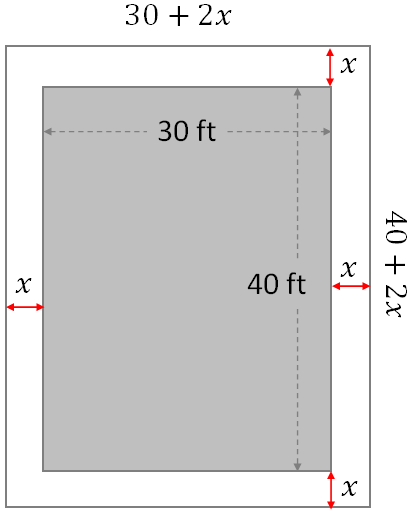
We are given that the area of the pool is 1200 ft2 and the length of the pool is 30 ft. From these, we can find the breadth of the pool:
$\textup{breadth}=\dfrac{\textup{Area}}{\textup{length}}=\dfrac{1200}{30}=40$ ft.
Let $x$ be the width of the walkway, which we need to find.
From the figure, the area of the walkway
$=$Total area of the pool and the walkway $-$Area of the pool
$=(40+2x)(30+2x)-1200$
$=1200+80x+60x+4x^2-1200$
$=140x+4x^2$
This area can be at most the available material, 296 ft2. So, for the maximum area,
$140x+4x^2=296$
This is a quadratic equation, move everything to one side and solve for $x$:
$4x^2+140x-296=0$
$4$ is the common factor, you can divide that out:
$x^2+35x-74=0$
Factor and solve this:
$(x+37)(x-2)=0$
$x=-37$ or $ x= 2$
$x$ is the width of the walkway that cannot be negative. So, the only solution is $x=2$.
So, the maximum width of the walkway is $2$ ft. Thus, the width can be 2 ft or smaller.